Sndflo ← Back to sndflo.com

Blog

  • 5 Steps to Use AI SEO and Rank Faster (Easy Guide for SMBs)

    5 Steps to Use AI SEO and Rank Faster (Easy Guide for SMBs)

    SEO is a marathon. It's slow: often taking months to show real results. For a small business owner, that timeline is a problem. You need leads now, not next year.

    Traditional SEO agencies charge thousands a month. They spend weeks on "discovery" and "keyword research." You don't have that kind of time or budget. You need to move faster.

    AI has changed the game. It’s not just a trend: it’s a massive efficiency engine for your digital presence. By leveraging AI-based SEO strategies, you can bypass the manual grind. You can find the gaps, create the content, and climb the rankings in half the time.

    At Sndflo, we help businesses scale capacity without the hiring headache. SEO is a huge part of that. Here is your five-step guide to using AI to dominate search results and rank faster.

    1. Let AI Uncover Your "Money" Keywords

    Most SMBs target keywords that are too broad. "Plumber" is hard to rank for. "Emergency drain repair in Chicago" is where the money is. Finding these clusters manually used to take days of spreadsheet work.

    AI simplifies this. Tools like Semrush and Surfer SEO use machine learning to identify search intent. They group related keywords into clusters. Instead of writing one page for one keyword, you create a "content hub."

    This signals to Google that you aren't just a site with a few keywords. It shows you are an authority on the topic. AI identifies exactly what your customers are searching for and, more importantly, why they are searching for it.

    Start by asking AI to find "low-hanging fruit." These are keywords with high search volume but low competition. It's the fastest way to see a jump in your traffic.

    Interconnected glowing nodes representing AI keyword research and keyword clusters for SEO.
    A neon-glowing digital map showing interconnected data points, representing keyword clusters and search intent.

    2. Build High-Quality Content Briefs

    The biggest mistake SMBs make with AI is the "lazy prompt." You can't just ask an AI to "write a blog about HVAC repair." You’ll get generic, boring content that Google will ignore.

    The secret to ranking is the brief. AI works best when you give it structured guardrails. You need to define the audience. You need to set the tone: hopefully, a helpful, professional one.

    Use AI to analyze the current top three results for your target keyword. Ask the AI: "What is missing from these articles?" Maybe they lack a pricing guide. Maybe they don't explain the "how-to" well enough.

    Once you have those gaps, feed them into your content brief. Tell the AI exactly what headings to use and what unique value to add. This ensures your content is actually better than what’s already out there. Google rewards better, not just more.

    3. Master On-Page Optimization with Precision

    Google’s algorithms are smarter than ever. They look for more than just a keyword in a title tag. They look for "semantic richness": related terms that prove you know your stuff.

    Doing this manually is a nightmare. AI tools can scan your draft and compare it to the top-ranking pages in seconds. They’ll tell you exactly which terms to add. They’ll suggest better heading structures.

    Don't forget internal linking. This is the "secret sauce" of SEO. It helps Google crawl your site more effectively. AI can analyze your entire site and suggest exactly where to link from one post to another.

    It keeps users on your site longer. It builds authority. And most importantly, it’s all automated.

    Digital map of website architecture showing automated internal linking paths for better SEO.
    A futuristic digital workstation with holographic screens showing website structures and glowing internal link paths.

    4. Reverse-Engineer Your Competitors

    You don’t need to reinvent the wheel. Your competitors have already done the hard work of figuring out what ranks. You just need to do it better.

    AI can summarize multiple competitor pages at once. It can extract their main talking points and highlight their weaknesses. Does their site load slowly? Is their content three years old?

    This is where your high-performance Web Hosting comes in. Google loves speed. If you use AI to create better content and host it on a faster server than your competitor, you win.

    AI-driven competitor analysis tells you exactly where the "open goal" is. Find the questions they aren't answering. Answer them. Rank above them. Simple.

    5. Monitor, Forecast, and Pivot

    SEO isn't a "set it and forget it" task. You have to watch the data. But looking at Google Analytics can feel like reading a foreign language.

    Predictive AI tools change this. They don't just tell you what happened last month. They forecast what will happen next. They identify which pages are starting to slip before you lose the traffic.

    Use AI to track your rankings daily. If a page drops, the AI can suggest an update. Maybe a competitor added a new section. Maybe the search intent shifted. AI allows you to pivot your strategy in real-time.

    This proactive approach is what separates the winners from the businesses that get stuck on page two.

    Futuristic SEO dashboard displaying predictive analytics and upward-trending traffic growth.
    A sleek, modern dashboard with glowing neon charts and upward-trending lines, representing predictive SEO analytics.

    Speed is the New Authority

    In the world of SMBs, speed is everything. You can't wait six months for a return on investment. AI SEO isn't just about ranking: it's about efficiency. It's about scaling your capacity without hiring an entire marketing department.

    But here is the reality: Ranking on Google is only half the battle. What happens when the traffic arrives?

    If your SEO works, your phone starts ringing. If you’re busy on a job or out of the office, you miss that call. And a missed call is a missed customer. All that SEO effort is wasted.

    This is why we focus on more than just search. We believe in 24/7 engagement. Many businesses are switching to AI receptionists and voice agents to handle the influx of new leads.

    The Conversion Bridge

    Ranking faster means you need to convert faster. When a lead finds your site through your new AI-powered content, they expect an immediate response.

    If you don't answer, they go to the next person on the list.

    Consider adding a "missed call text back" service or an SMS chatbot to your strategy. This ensures that every lead your SEO generates is captured immediately. You spend the money to rank: make sure you keep the customer.

    Start Scaling Today

    You don't need a massive team to dominate your local market. You just need the right tools.

    1. Find the gaps with AI keyword research.
    2. Create value with structured content briefs.
    3. Optimize everything using AI editors.
    4. Outperform by analyzing competitor flaws.
    5. Stay ahead with predictive monitoring.

    Combine these five steps with high-performance hosting and a reliable AI voice agent, and you aren't just a small business anymore. You're a high-efficiency lead machine.

    No more hiring headaches. No more wasted marketing spend. Just growth.

    A central AI core in a modern office representing automated business scaling and efficiency.
    A neon-lit office environment with a central AI core, symbolizing a small business powered by high-performance automation.

    The digital landscape is moving fast. If you aren't using AI to handle the heavy lifting, you're leaving money on the table.

    Ready to see how AI can transform your business from the inside out?

    Let's talk. We help SMBs like yours deploy these exact strategies every day. Visit Sndflo to explore our AI solutions and start ranking: and converting( faster.)
  • How to Scale Your Service Business Without the Hiring Headache

    How to Scale Your Service Business Without the Hiring Headache

    Growth is a trap.

    Most business owners think scaling requires a bigger team. You sign more clients, so you hire more people. You hire more people, so you need more managers. Suddenly, you aren't doing the work you love anymore. You're just managing personalities and payroll.

    It’s the "hiring headache." It’s expensive, slow, and risky.

    But it’s 2026. The old rules don't apply. You can double your capacity without posting a single job ad on LinkedIn. You can grow your revenue while keeping your team lean.

    Here is how you scale your service business using AI and smart systems.

    Stop Being the Bottleneck

    Your business has a front door. Right now, that door is likely your phone or your inbox.

    When a lead calls and you don't answer, they move to the next person on Google. When a client emails a simple question and waits six hours for a reply, your "service" starts to feel like a chore.

    The traditional fix? Hire a receptionist.

    But a receptionist works 40 hours a week. They take lunch breaks. They get sick. They cost $40k to $60k a year plus benefits.

    Instead, deploy an AI receptionist. We aren't talking about those frustrating "press 1 for sales" menus. We're talking about 24/7 voice agents that sound human, understand context, and actually solve problems.

    These agents answer the phone on the first ring. They book appointments directly into your calendar. They answer FAQs about your pricing and service area. They never have a bad day.

    By automating the "front desk," you reclaim 10 to 15 hours of your week. That’s time you can spend on high-level strategy or billing.

    AI receptionist core illustrating 24/7 voice agent services for small businesses.

    Kill the Voicemail Dead

    Voicemail is where leads go to die.

    In a world of instant gratification, nobody wants to leave a message and "hope" for a callback. They want a response now. If you aren't providing it, your competitors are.

    This is why missed call text back is the ultimate scaling tool for SMBs.

    It’s a simple automation. If you miss a call, the system immediately sends a text: "Hey, it’s Drew from Sndflo. Sorry I missed you. How can I help?"

    This converts a "lost" lead into an active conversation. From there, an SMS chatbot can take over. It can qualify the lead, ask about their budget, and even send them a link to pay a deposit.

    You’re scaling your sales capacity without a sales team. You’re capturing revenue that used to slip through the cracks. It’s efficient. It’s effective.

    For a deeper dive into why this shift is happening, check out our thoughts on the death of voicemail.

    Productize Your Genius

    Scaling a service business is hard because every project feels "custom."

    Custom work is a nightmare to delegate. It requires your brain for every decision. To scale without hiring, you must turn your services into products.

    Stop selling "consulting" or "landscaping." Start selling "The 30-Day Strategy Audit" or "The Seasonal Curb Appeal Package."

    Give it a fixed scope. Give it a fixed price. Create a step-by-step checklist for how it gets done.

    When your service is productized, you can use AI tools to handle the heavy lifting. You can use LLMs to draft reports, analyze data, or generate creative briefs based on your specific SOPs (Standard Operating Procedures).

    You become the editor, not the writer. You become the architect, not the bricklayer.

    Abstract blocks representing productized services for scalable business growth.

    High-Performance Foundations

    You can't build a skyscraper on a swamp.

    Many small businesses try to scale their digital presence while using $5-a-month shared hosting. Their website is slow. It crashes when they run an ad campaign.

    If your site takes more than three seconds to load, you’re losing 40% of your traffic. That’s wasted marketing spend.

    High-performance web hosting isn't a luxury. It’s a scaling requirement. You need a platform that handles traffic spikes and keeps your AI integrations running smoothly.

    Speed is a feature. Reliability is a growth strategy. When your infrastructure is solid, you don't need a "web guy" on call 24/7 to fix crashes. The system just works.

    AI-Based SEO: The Silent Salesman

    Traditional SEO is a slow, manual grind. You hire an agency, pay them a massive retainer, and wait six months for a blog post to rank.

    That’s the old way.

    AI-based SEO strategies allow small businesses to compete with the giants. You can use AI to identify "content gaps" in your local market. You can generate hyper-specific landing pages for every suburb you serve in minutes, not weeks.

    This isn't about "spamming" the internet. It's about being the most helpful resource for your customers.

    When a local homeowner searches for "best AC repair in [City Name]," your AI-optimized content should be the first thing they see. This creates a steady stream of inbound leads that your AI receptionist can then book.

    It’s a closed loop of growth that doesn't require a single new employee.

    Digital map showing AI-based SEO driving local search traffic and inbound leads.

    Standardize Before You Automate

    A common mistake is trying to automate a mess.

    If your current process is disorganized, AI will just help you fail faster. Before you deploy a voice agent or a chatbot, look at your workflow.

    • How do you onboard a new client?
    • How do you handle a refund?
    • How do you collect a testimonial?

    Write these down. These are your SOPs.

    Once a process is documented, it’s easy to see which parts an AI can handle. Usually, it's the repetitive, "low-value" tasks.

    By offloading the boring stuff to AI, your existing team (even if it’s just you) becomes three times more productive. That is true scaling.

    The Cost of Doing Nothing

    Let’s talk numbers.

    Hiring a new employee costs roughly 1.5x to 2x their salary when you factor in taxes, equipment, and training. If you hire someone for $50k, they actually cost you $75k.

    An AI-driven tech stack: hosting, voice agents, SMS automation, and SEO tools: typically costs less than a single month’s salary for that employee.

    The ROI isn't just in the money saved. It’s in the flexibility.

    If the economy slows down, you can't "turn off" an employee without a lot of pain. You can, however, scale your software usage down in seconds.

    Scaling without the hiring headache is about building a "resilient" business. One that grows when times are good and stays lean when they aren't.

    Resilient digital network representing automated systems to scale without hiring.

    Your Roadmap to 24/7 Capacity

    You don't have to do this all at once. Start where the pain is greatest.

    1. The Lead Leak: Implement missed call text back today. It takes ten minutes and pays for itself with the first saved lead.
    2. The Time Drain: Identify the questions you answer ten times a day. Feed those into an AI receptionist.
    3. The Growth Engine: Audit your hosting and SEO. Make sure your digital storefront is ready for more traffic.

    You started your business for freedom, not to become a full-time recruiter and HR manager.

    The tools are here. The tech is ready. The only thing missing is your decision to stop doing things the hard way.

    Let’s Build Your System

    At Sndflo, we help SMBs build these systems. We believe in high performance and low friction.

    Whether you need a receptionist who never sleeps or a website that never crashes, we have the solutions to help you scale.

    You don't need a bigger team. You need a better flow.

    Let's get started. Visit Sndflo to see how we can automate your growth.

  • Website Speed Matters: Why Your Current Hosting Is Costing You Customers

    Website Speed Matters: Why Your Current Hosting Is Costing You Customers

    You’re losing money.

    You might not see it in your bank statement yet. You might not see it in your daily analytics. But it’s happening. Every time a potential customer clicks your link and stares at a white screen for more than three seconds, you’ve lost them.

    In the digital world, speed isn't a luxury. It’s a survival metric.

    If your website takes five seconds to load, you aren't just "a little slow." You’re invisible. Your current hosting might be cheap, but it’s the most expensive mistake your business is making.

    Let’s look at why.

    The Three-Second Death Sentence

    Patience is a relic of the past.

    Research shows that 76% of consumers have abandoned a shopping cart because the site was too slow. Even worse, 43% of users get frustrated if a site takes more than 10 seconds. Most don’t even wait that long.

    The industry standard is now 2 to 3 seconds. Anything beyond that is a gamble.

    When your site lags, your bounce rate spikes. A "bounce" is more than a statistic. It’s a human being who wanted to give you money but decided your business wasn’t worth the wait. They didn't just leave your site: they went to your competitor.

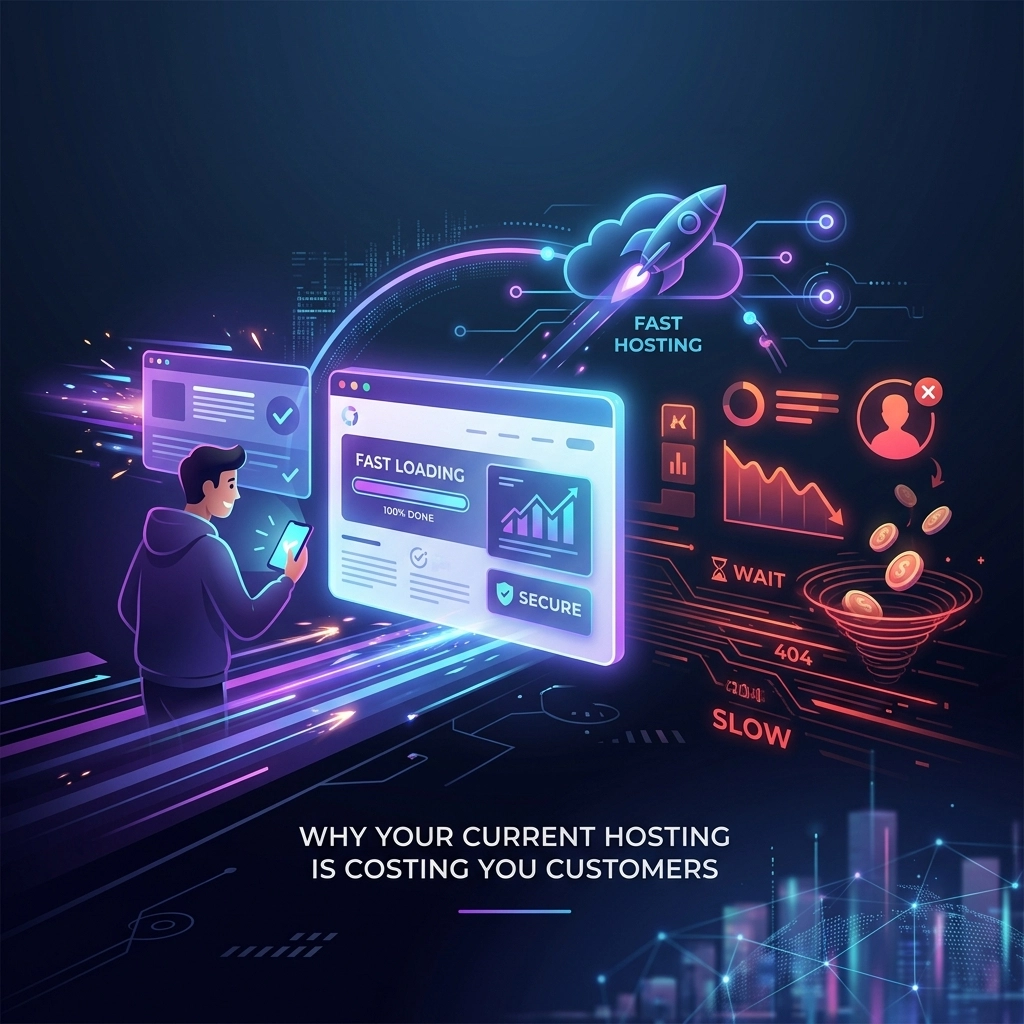
    A glowing hourglass with digital sand illustrating how slow website speed leads to customer abandonment.

    The Hidden Cost of "Cheap" Hosting

    Most small businesses start with $5-a-month shared hosting.

    It seems like a bargain. You get a place on the web for the price of a latte. But here’s the reality: you’re sharing a server with thousands of other websites.

    When one of those sites gets a traffic spike, your site crawls to a halt. When their security is compromised, your site is at risk. You’re living in a digital tenement house where the neighbors control your electricity.

    Cheap hosting is a leaky bucket. You spend money on ads and SEO to pour leads into the bucket, but they leak out through the holes in your performance.

    A one-second delay in page load time results in a 7% loss in conversions. If your site makes $1,000 a day, that one second is costing you over $25,000 a year. Suddenly, that $5 hosting plan looks incredibly expensive.

    Google is Watching (And Judging)

    Google has a single goal: to provide the best possible experience for its users.

    If Google sends someone to a slow website, it reflects poorly on them. To prevent this, they’ve made site speed a critical ranking factor. This is part of their "Core Web Vitals."

    If your site is slow, you will never rank on the first page. It doesn't matter how good your keywords are. It doesn't matter how many blog posts you write. If your technical foundation is weak, your SEO efforts are wasted.

    High-performance hosting isn't just about the user. It’s about the algorithm. Fast sites get indexed faster. They rank higher. They stay there longer.

    At Sndflo, we integrate AI-based SEO strategies with high-performance infrastructure because speed and visibility are two sides of the same coin.

    Mobile Users Won't Wait

    Your customers aren't sitting at desks with fiber-optic internet.

    They’re on their phones. They’re on 5G, 4G, or even spotty coffee shop Wi-Fi. If your site is heavy and your hosting is slow, their mobile experience will be a nightmare.

    Google uses mobile-first indexing. This means Google looks at the mobile version of your site to decide where you rank. If your mobile site takes five seconds to load on a standard connection, you’re effectively buried.

    A one-second improvement in mobile site speed can increase conversions by up to 27%. That’s a massive jump for a relatively small technical fix.

    Smartphone with neon light trails symbolizing fast mobile site speed and improved user conversion rates.

    The Psychology of Trust

    Speed is a trust signal.

    Think about the last time you visited a site that felt "clunky." The images took forever to load. The buttons didn't respond immediately. Did you feel comfortable putting your credit card info into that site?

    Probably not.

    A fast website feels professional. It feels secure. It tells the customer that you care about their time. It tells them that your business is modern and efficient.

    One in two consumers will permanently lose trust in a brand after just five poor website experiences. You only get a handful of chances before you’re blacklisted in the mind of your customer.

    Scaling Without the Headache

    As your business grows, your hosting needs to grow with it.

    Traditional hosting often requires you to manually upgrade plans, migrate databases, and handle technical overhead. It’s a hiring headache you don't need.

    Modern high-performance hosting scales automatically. It uses technologies like NVMe storage, advanced caching, and Content Delivery Networks (CDNs) to ensure your site stays fast whether you have ten visitors or ten thousand.

    This is where the consultant-led approach matters. You shouldn't have to be a system administrator to run a successful business. You need a partner who handles the infrastructure while you handle the growth.

    Modular glowing cubes assembling to represent scalable web hosting solutions for growing small businesses.

    More Than Just Page Loads

    Speed isn't just about how fast your homepage appears. It’s about how fast your business responds.

    In 2026, a fast website is the foundation for other high-speed tools. If your site is slow, your integrated AI receptionists or SMS chatbots might experience lag.

    A high-performance site allows for seamless integration of:

    • 24/7 AI voice agents.
    • Real-time missed call text back.
    • Interactive AI receptionists.

    When a customer calls and gets an immediate AI response, or texts your business and gets an instant reply, that's "speed" in their eyes. But it all starts with a fast digital core.

    If you're still relying on old-school voicemail, you're already behind. You can read more about why businesses are switching to AI receptionists here.

    The Technical Reality: What Makes a Host "Fast"?

    Not all servers are created equal.

    If you want to know if your current hosting is holding you back, look for these three things:

    1. SSD vs. NVMe Storage
    Standard SSDs are fast. NVMe is five times faster. High-performance hosting uses NVMe to pull data instantly.

    2. Server-Level Caching
    Instead of your website generating every page from scratch every time someone visits, the server should keep a "snapshot" ready to go. This cuts load times in half.

    3. Global CDN
    A Content Delivery Network stores copies of your site in servers all over the world. If a customer is in London, they get your site from a London server, not one in Chicago.

    If your host doesn't offer these as standard, you’re paying for 2015 technology in a 2026 world.

    Modern high-performance servers with glowing fiber-optic cables representing fast hosting and low latency.

    Stop Leaving Money on the Table

    You've worked hard to build your brand. You've invested time in your products and services. Don't let a slow server undo all that work.

    Your website should be an asset, not a liability. It should be a high-speed conversion machine that works 24/7 to capture leads and close sales.

    The switch to high-performance hosting is the easiest ROI you will ever find. You don't need a new marketing strategy. You don't need a new logo. You just need to stop making your customers wait.

    Let’s Fix Your Speed

    At Sndflo, we don't just host websites. We build performance engines.

    We combine lightning-fast hosting with AI-driven tools to ensure you never miss a lead again. Whether it’s through AI-based SEO or 24/7 voice agents, we help you scale capacity without the hiring headache.

    Your current hosting is costing you customers. It’s time to move to something that pays for itself.

    A glowing energy core representing a powerful website conversion engine driven by fast hosting and AI.

    Ready to see what high-performance hosting can do for your bottom line?

    Let’s talk. Visit us at Sndflo to get started.

  • Web Hosting Matters: Why Your Site Speed Is Sabotaging Your Local SEO

    Web Hosting Matters: Why Your Site Speed Is Sabotaging Your Local SEO

    You built a beautiful website. You hired a photographer for the headshots. You spent hours writing the "About Us" page.

    But nobody is calling.

    You search for your business on Google. You aren't in the top three. You aren't even on the first page. You check your keywords, and they look fine. You have reviews. You have a physical office.

    The culprit is hiding in the basement. It’s your web hosting.

    Most small business owners treat hosting like a utility: like water or electricity. You want the cheapest option that keeps the lights on. That choice is killing your local SEO.

    In the digital age, speed is more than a luxury. It is a ranking factor. If your site takes forever to load, Google will bury you.

    Here is why your slow site is sabotaging your growth and how you can fix it.

    The Google Grade: Core Web Vitals

    Google doesn't guess anymore. They measure.

    In recent years, Google introduced Core Web Vitals. These are specific metrics that track how users experience your page speed. They look at how fast the largest image loads. They look at how quickly the site becomes interactive. They look at whether the layout jumps around while loading.

    If your web host is slow, your scores will be red.

    When your scores are red, Google treats your site as a "bad result." They want to provide the best experience for their users. A slow site is a bad experience.

    Think of it like a restaurant. If a customer walks in and waits ten minutes for a menu, they leave. Google is the concierge. If they know a restaurant has slow service, they stop recommending it.

    Local SEO is a game of thin margins. Your competitors are likely targeting the same zip codes. If their site loads in 1.2 seconds and yours takes 4.5, they win the "Local Pack" every time.

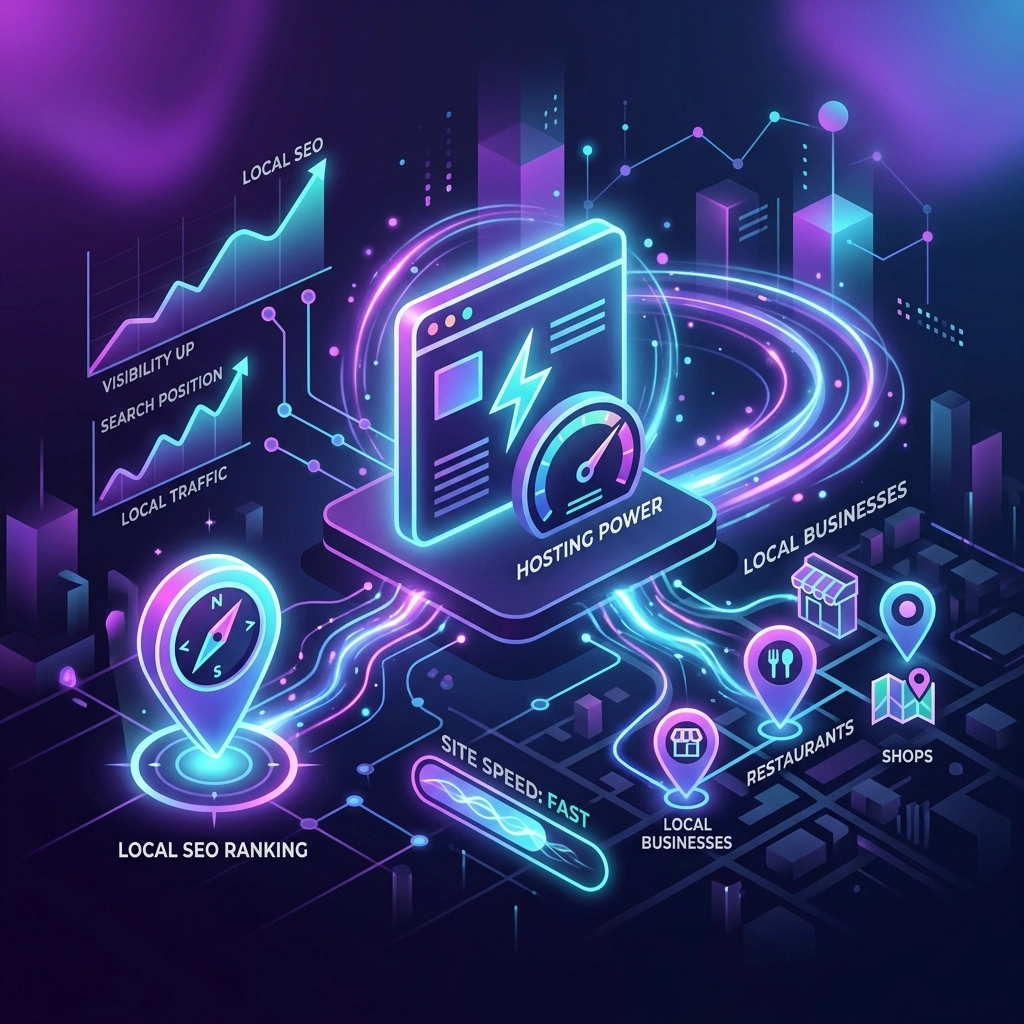
    Digital speedometer representing fast website loading speed for improved local SEO rankings.

    The Three-Second Death Sentence

    Patience is dead.

    Data shows that 40% of people abandon a website if it takes more than three seconds to load. That is nearly half of your potential traffic gone before they even see your logo.

    This creates a "bounce rate" nightmare.

    When a user clicks your link in search results and then immediately hits the "back" button, Google notices. This signal tells them your site didn't satisfy the user's intent.

    Low engagement leads to lower rankings. It becomes a downward spiral.

    Slow hosting causes high bounce rates. High bounce rates cause lower rankings. Lower rankings lead to zero leads.

    You can't afford to lose 40% of your leads because of a $5-a-month hosting plan. That "saving" is costing you thousands in lost revenue.

    Mobile is the Only Local That Matters

    Local search happens on the move.

    Over 60% of local searches occur on mobile devices. People are looking for a plumber while standing in a flooded kitchen. They are looking for a lawyer while sitting in their car. They are looking for your business on 5G or spotty LTE connections.

    Mobile-first indexing means Google looks at your mobile site speed first.

    If your hosting isn't optimized for mobile delivery, you’re invisible. Mobile users are even more impatient than desktop users. 53% of mobile visits are abandoned if a page takes longer than three seconds to load.

    At five seconds, the bounce rate on mobile skyrockets by 90%.

    Most cheap "shared" hosting plans cram thousands of websites onto one server. When one site gets a spike in traffic, everyone else slows down. On a mobile device, that lag feels like an eternity.

    High-performance web hosting uses specialized servers. They use NVMe storage and Content Delivery Networks (CDNs) to push your data to the closest tower. It’s the difference between a dial-up connection and a fiber optic line.

    Smartphone with a holographic city map illustrating fast mobile performance for local business searches.

    Speed-to-Lead: The New Gold Standard

    SEO gets them to your site. Speed gets them to the finish line.

    If your site is fast, they find your phone number. If they find your phone number, they call. But what happens if you’re busy?

    This is where the "speed-to-lead" concept extends beyond your website. If your site is fast but your response time is slow, the SEO effort is wasted.

    At Sndflo, we focus on the entire performance funnel. A fast website gets the click. An AI receptionist gets the deal.

    Imagine a customer finds your fast-loading site. They click to call. You’re on a job site and can’t answer. Normally, that lead goes to your voicemail: and then to your competitor.

    With an AI voice agent, that call is answered on the first ring. 24/7. No hiring headache. No missed opportunities.

    If you want to understand how this shift is changing the game, check out our post on the death of voicemail.

    Your website speed and your response speed are two sides of the same coin. Both are required for modern local SEO success.

    Crawl Budgets and Technical Debt

    Google uses "bots" to read your website. This process is called crawling.

    Google assigns a "crawl budget" to every site. This is the amount of time and energy their bots will spend on your pages.

    If your server is slow to respond, the bot gets frustrated. It will stop crawling and move on to the next site. This means your new blog posts, updated pricing, or latest testimonials might not get indexed for weeks.

    If Google doesn't index your content, you don't exist in search results.

    Cheap hosting creates technical debt. You save a few dollars today, but you pay for it in "dark" pages that never see the light of a search result.

    High-performance hosting ensures that every time Google visits, your server responds instantly. It allows the bots to see everything you have to offer.

    Geometric digital bots crawling a network of data to represent efficient Google search indexing.

    Scaling Without the Hiring Headache

    Most SMB owners think that to get "better" tech, they need to hire a "tech guy."

    They think they need a webmaster or an IT manager. This isn't true. Modern hosting and AI solutions allow you to scale your capacity without adding to your payroll.

    High-performance hosting is managed. The provider handles the security, the updates, and the speed optimizations. It’s like having an enterprise-grade IT team for the price of a nice dinner.

    The same applies to your customer service. Instead of hiring a front-desk person to handle the influx of leads from your new, faster website, you can use an AI-based SMS chatbot.

    When someone lands on your site and has a question, they don't want to wait for an email. They want to text.

    A missed call text back service ensures that even if you're offline, the conversation stays alive. You’re capturing the lead while your site speed is still fresh in their mind.

    What to Look for in a Web Host

    If you’re ready to stop sabotaging your SEO, you need to know what to ask for. Don't let a salesperson dazzle you with "unlimited" space. Space is cheap. Speed is expensive.

    Here is your checklist:

    • SSD or NVMe Storage: Traditional hard drives are too slow. You want the same tech found in modern laptops.
    • Server-Side Caching: This stores a "snapshot" of your site so the server doesn't have to rebuild it for every visitor.
    • Global CDN: This puts your files on servers all over the world. Even for local SEO, this helps with reliability.
    • HTTP/3 Support: This is the latest protocol for transferring data. It’s faster and more secure.
    • Dedicated Resources: Avoid "shared" plans where you share RAM with 5,000 other people.

    At Sndflo, we don't just talk about AI. We understand the infrastructure that makes AI-based SEO strategies work. You can't run a Ferrari engine in a lawnmower frame. Your hosting is the frame.

    Futuristic server core with glowing circuits showing high-performance web hosting for small businesses.

    The Bottom Line

    Your website is your digital storefront. If the door is stuck and the lights are flickering, people won't come in.

    Web hosting matters because Google cares about the user. If the user is happy, Google is happy. If Google is happy, you’re on the first page.

    Stop letting a $5 hosting plan dictate the future of your business. Invest in speed. Invest in performance.

    When your site loads in under a second, you’ll see the difference in your rankings. When you pair that speed with AI receptionists and SMS chatbots, you’ll see the difference in your bank account.

    Local SEO isn't just about keywords. It's about being the fastest, most reliable answer to a neighbor's problem.

    Let's make your site impossible to ignore.

    Learn more about our AI solutions at Sndflo.

  • How to Double Your Capacity Without Hiring a Single Person (Easy Guide for Business Owners)

    How to Double Your Capacity Without Hiring a Single Person (Easy Guide for Business Owners)

    You’re staring at a mounting pile of tasks. Your team is stretched thin. You’re losing sleep over missed opportunities.

    The standard advice? "You need to hire."

    But hiring is expensive. It’s risky. It takes months to find the right person and even longer to train them. By the time they’re productive, you’re already looking for the next hire.

    It’s a cycle that drains your bank account and your sanity.

    What if you could double your capacity without adding a single person to your payroll? We’re talking about scaling your output while keeping your overhead exactly where it is.

    It isn't magic. It's leverage.

    The Hiring Trap vs. The Leverage Limit

    Most small business owners hit a wall. They think it’s a people limit. Usually, it’s actually a clarity limit.

    Capacity isn't just about how many hours your team works. It’s about how much friction exists in those hours. When your processes are messy, your team spends 40% of their day managing the mess instead of doing the work.

    When you hire into a messy system, you just get a more expensive mess.

    We’re going to show you how to remove that friction using AI, automation, and high-performance systems. This is how you scale quietly and profitably.

    Business owner using automation as leverage to scale company capacity effortlessly.

    1. Stop Losing Leads to the Voicemail Abyss

    Every time your phone rings and you don’t answer, you lose money. It’s that simple.

    In a world of instant gratification, your customers won't leave a voicemail. They’ll just hang up and call the next business on Google. You’re paying for marketing only to let the leads slip through your fingers because your team is busy.

    You don't need a 24/7 in-house receptionist. You need an AI voice agent.

    These aren't the robotic menus of the 90s. These are sophisticated AI agents that sound human, understand context, and never take a lunch break.

    They can:

    • Answer common questions about your services.
    • Qualify leads before they ever reach your desk.
    • Book appointments directly into your calendar.
    • Transfer urgent calls to the right person.

    By deploying an AI receptionist, you instantly gain 40+ hours of productivity per week. That’s a full-time employee’s worth of work for a fraction of the cost.

    The death of voicemail is real. Stop letting it kill your growth.

    2. Deploy Missed Call Text Back (The Silent Revenue Multiplier)

    Sometimes, the best way to handle a call is not to answer it at all, provided you engage immediately via text.

    If you’re on a job site or in a meeting, you can’t pick up the phone. But you can send a text. Or rather, your system can.

    Missed call text back is a simple automation. When a call goes unanswered, the system instantly sends a text: "Hey, it’s Sndflo. Sorry we missed your call. How can we help?"

    The response rate is staggering. Customers feel acknowledged. They stop searching for competitors. Your "capacity" to handle inbound interest just doubled because you’re no longer tethered to the physical phone.

    Add an SMS chatbot to that sequence, and you can automate the entire intake process. From "I need a quote" to "I'm booked for Tuesday" without you touching your phone once.

    A smartphone using AI lead capture to automate customer intake via SMS.

    3. High-Performance Web Hosting is Your Foundation

    You might wonder what web hosting has to do with capacity. Everything.

    Your website is your hardest-working employee. It works 24/7. It tells your story. It collects leads.

    If your site is slow, it’s failing at its job. If your hosting is unreliable, your "digital employee" is constantly calling in sick.

    High-performance web hosting ensures your site loads in under two seconds. It keeps your lead forms running smoothly. It handles traffic spikes without crashing.

    When your website works perfectly, your team spends less time dealing with "tech issues" and "missing leads" and more time closing deals. At Sndflo, we view your digital infrastructure as the backbone of your capacity.

    4. AI-Based SEO: The Passive Lead Machine

    Scaling requires a steady flow of leads. Most owners try to solve this by throwing money at ads. Ads are a "pay-to-play" game. The moment you stop paying, the leads stop coming.

    AI-based SEO is different.

    We use AI to identify exactly what your customers are searching for. Then, we create high-quality, targeted content that ranks. This isn't about spamming the internet. It's about being the most helpful resource in your niche.

    Once your SEO starts working, it creates a "passive capacity" for lead generation. You don't need a sales team to cold call when your inbox is filling up with people who found you organically.

    It’s about building an asset that grows in value over time.

    Fast automated communication nodes connecting business lead generation assets.

    5. Make Work Repeatable (The End of "How Do I…?")

    The biggest drain on your capacity is "The Brain Drain."

    If every task requires you to explain it, you are the bottleneck. You can't scale if everything lives in your head.

    To double your capacity, you must make work repeatable.

    1. Document the process: Use simple videos or bullet points.
    2. Centralize the data: Use a CRM so everyone knows exactly where a project stands.
    3. Automate the hand-off: When Task A is done, Task B should be assigned automatically.

    When you remove the need for constant coordination, you free up hours of time every single week. Your current team becomes twice as effective because they aren't waiting for instructions.

    6. The Shift: Decisions vs. Tasks

    As a business owner, your job isn't to do tasks. Your job is to make decisions.

    But most owners are so bogged down in tasks: answering phones, replying to basic emails, checking schedules: that they have no capacity for high-level decisions.

    By using AI voice agents and automated tools, you offload the tasks.

    This allows you to focus on the 20% of activities that drive 80% of your revenue. This is how you double your capacity. You aren't doing "more" work; you're doing "better" work.

    7. Eliminate Process Waste

    Take a look at your current workflow. Where is the waste?

    • Redundant approvals: Does every small expense really need your signature?
    • Information silos: Is your team constantly asking each other for client details?
    • Manual data entry: Are you still typing names and numbers into a spreadsheet?

    Every manual step is a capacity killer.

    If you can automate it, do it. If you can eliminate it, even better.

    Sustainable organic growth using AI SEO strategies to build a lead machine.

    The Calm Way to Scale

    Most people think growth is chaotic. They think it requires "the hustle."

    We disagree.

    Growth should be calm. It should be predictable. It should be built on systems that work while you sleep.

    When you deploy AI receptionists, missed call text back, and high-performance SEO, you aren't just getting more work done. You're building a business that doesn't rely on your physical presence every second of the day.

    You don't need a hiring spree. You need a system upgrade.

    Ready to Double Your Capacity?

    You’ve seen the blueprint. The tools are available. The only question is whether you’re ready to stop being the bottleneck in your own business.

    We help SMBs deploy these exact strategies every day. We don't do fluff. We do performance.

    If you’re ready to scale without the hiring headache, we’re ready to help.

    Let’s talk about your system.

    Explore Sndflo AI Solutions

  • AI SEO 101: A Beginner’s Guide to Mastering Local Search Visibility

    AI SEO 101: A Beginner’s Guide to Mastering Local Search Visibility

    You want to be found. It’s that simple. When someone in your town picks up their phone and searches for your service, you need to be the first name they see. Not the third. Not the second page. The very top.

    The rules have changed. Old-school SEO was about stuffing keywords into a slow website. Today, search is driven by Artificial Intelligence. Google, Bing, and even AI agents like ChatGPT are deciding who gets the business.

    This is Local SEO in 2026. It’s faster. It’s smarter. And if you aren't using AI to help you rank, you’re already behind.

    The New Reality of Local Search

    Your customers don’t search like they used to. They don't just type "plumber" into a desktop computer. They talk to their cars. They ask their watches. They tell an AI assistant to "find the best coffee shop open now that has seating."

    AI search engines aggregate billions of data points. They look at your location, your hours, your reviews, and even how fast you respond to customers. They want to provide the best experience possible.

    If your business data is messy, the AI ignores you. If your website is slow, you’re invisible. Mastering local search visibility isn't a luxury, it's survival.

    Google Business Profile: Your Digital Front Door

    Everything starts here. Your Google Business Profile (GBP) is the most important asset you own. It is the primary data source for Google’s local AI.

    You need to claim it. You need to verify it. And you need to optimize it.

    Start with the basics. Your name, address, and phone number (NAP) must be identical everywhere. If your website says "Street" and your GBP says "St.", fix it. AI rewards consistency. It builds trust.

    But don't stop at the address. Add high-quality photos. List every single service you offer. Use the Q&A section to answer common customer hurdles before they even call you.

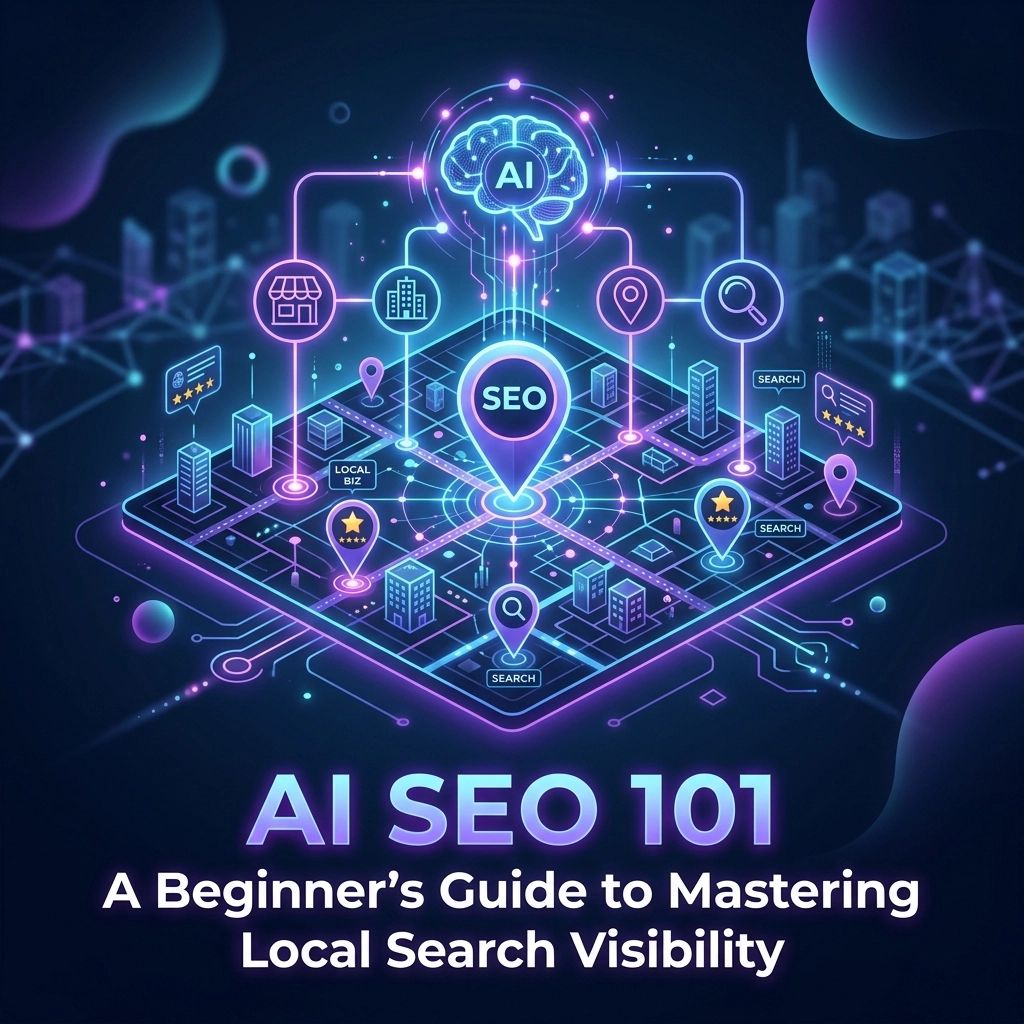
    Glowing digital city map highlighting an optimized business profile for local search results.

    AI Agents and the Speed of Response

    Here is a secret most SEO "experts" won't tell you. Search engines track how you interact with customers. If a user clicks your "Call" button and the line goes to a full voicemail, Google knows.

    A missed call is a signal of a poor customer experience. Too many missed calls, and your ranking can slip. This is where AI changes the game for small businesses.

    At Sndflo, we help businesses deploy AI receptionists that work 24/7. These aren't old-school robots. They are sophisticated voice agents that handle your calls, book appointments, and answer questions.

    When you never miss a call, your engagement metrics skyrocket. Better engagement leads to better visibility. It's a feedback loop that works in your favor.

    If you're still relying on traditional voicemail, you’re losing more than just a lead, you're losing your spot on the map. You can read more about why this shift is happening in our post on the death of voicemail.

    Content That AI Actually Wants to Read

    Keywords still matter, but intent matters more. AI doesn't just look for the word "dentist." It looks for content that proves you are a local authority.

    Stop writing generic blog posts. Write about your community. Mention local landmarks. Talk about the specific problems people in your zip code face.

    Use AI to help you brainstorm these topics, but keep the soul in the writing. AI-based SEO strategies mean using tools to analyze what your competitors are missing and then filling that gap with better, faster content.

    Keep your sentences short. Use clear headings. Make it easy for an AI crawler to understand exactly what you do and where you do it.

    The Power of Missed Call Text Back

    Imagine a potential customer finds you on Google Maps. They call. You’re busy with another client. Usually, they’d just move to the next business on the list.

    But then, they get a text. "Hi, sorry we missed you! How can we help?"

    Suddenly, you’ve captured the lead. This is missed call text back. It keeps the conversation on your platform. Search engines see this continued interaction and mark your business as highly relevant and responsive.

    Integrating SMS chatbots into your workflow ensures no lead goes cold. It’s scaling your capacity without the hiring headache. You don't need a massive front-desk team when your AI handles the first touch.

    Smartphone screen displaying automated AI text message responses for small business leads.

    Reviews: Your Social Proof for Robots

    Reviews are the fuel for local SEO. But it’s not just about the number of stars. It’s about the content of the reviews.

    When a customer mentions a specific service: like "emergency roof repair": Google’s AI associates your business with that specific search term.

    You need a system to generate reviews consistently. Don't leave it to chance. Use automated SMS reminders to ask for feedback after a job is done.

    And here’s the kicker: You must respond to your reviews. All of them. The good, the bad, and the weird. It shows the algorithm that you are active and engaged.

    High-Performance Hosting is Non-Negotiable

    Your SEO strategy is only as good as your foundation. If your website takes four seconds to load on a mobile device, half of your traffic is gone before the page even appears.

    Google uses "Core Web Vitals" to rank sites. These are technical metrics that measure speed and stability. For a small business, standard "cheap" hosting isn't enough anymore.

    You need high-performance web hosting solutions. You need servers optimized for speed and security. A fast site isn't just better for the user: it’s a massive ranking signal for AI search engines.

    At Sndflo, we ensure your digital infrastructure is as capable as your team. Explore our solutions at https://ai.sndflo.com to see how we handle the technical heavy lifting for you.

    Futuristic digital infrastructure representing fast web hosting for better search rankings.

    Optimizing for Voice Search and AI Chatbots

    People talk to their phones. They use natural language. They don't say "Plumber Chicago." They say "Who is the best plumber near me that can fix a leak tonight?"

    To rank for these queries, you need to answer those specific questions on your website.

    Create a "Frequently Asked Questions" page. Use the exact language your customers use. This "long-tail" content is exactly what AI agents like Gemini or ChatGPT pull from when they provide answers to users.

    The "Near Me" Strategy

    "Near me" isn't a keyword you just type on a page. It’s a result of your proximity and your relevance.

    To win "near me" searches, you need local citations. These are mentions of your business on other websites, like Yelp, Yellow Pages, or local chamber of commerce directories.

    The AI looks at these citations to confirm your location. If your info is consistent across 50 different sites, the AI is 100% sure you are where you say you are. That certainty leads to higher rankings.

    Interconnected digital nodes showing local business citations for consistent NAP data.

    Scaling Without the Headache

    Many SMB owners fear SEO because it feels like a second job. They think they need to hire a massive agency or a full-time marketing person.

    You don't.

    You can scale your capacity by leveraging AI tools. Use an AI receptionist to handle the influx of calls that come from your improved ranking. Use SMS chatbots to nurture the leads that come from your new web traffic.

    By automating the routine tasks, you free up your time to actually run your business. You get the growth of a large corporation with the overhead of a small shop.

    Your AI SEO Checklist

    Ready to start? Follow these steps to take control of your local visibility:

    1. Claim your Google Business Profile. Fill out every section. Every single one.
    2. Audit your NAP. Ensure your Name, Address, and Phone number are identical across the web.
    3. Upgrade your hosting. Don't let a slow server kill your rankings.
    4. Deploy an AI receptionist. Never miss a call and keep your engagement signals high.
    5. Automate your reviews. Ask every customer for feedback via SMS.
    6. Create local content. Answer the questions your customers are actually asking.

    Abstract glowing stairs representing a step-by-step checklist for local SEO growth.

    The Future is Proactive

    Local search isn't a "set it and forget it" task. It’s an ongoing process of staying relevant. The businesses that win are the ones that adapt to how customers actually behave.

    They want instant answers. They want easy booking. They want to know you’re the local expert.

    AI SEO is simply the process of making it easy for the machines to see that you are the best choice for the humans.

    Let's make sure you're the one they find.

    For more insights on how to automate your growth and master the new digital landscape, visit us at Sndflo. We help you navigate the noise so you can focus on the work.

Blog Posts